
First Premium Order: A Walkthrough of the Export Documentation
A first premium order produces documents in a predictable sequence, and each one has a natural moment to be requested. Ask for them all at the end and the file arrives late and incomplete; ask for each one as its stage closes and the export file assembles itself. The walkthrough below follows a single order from enquiry to shipment, naming what should exist at each stage, who normally holds it, and the questions that keep it from being deferred to the last week.
Key takeaways
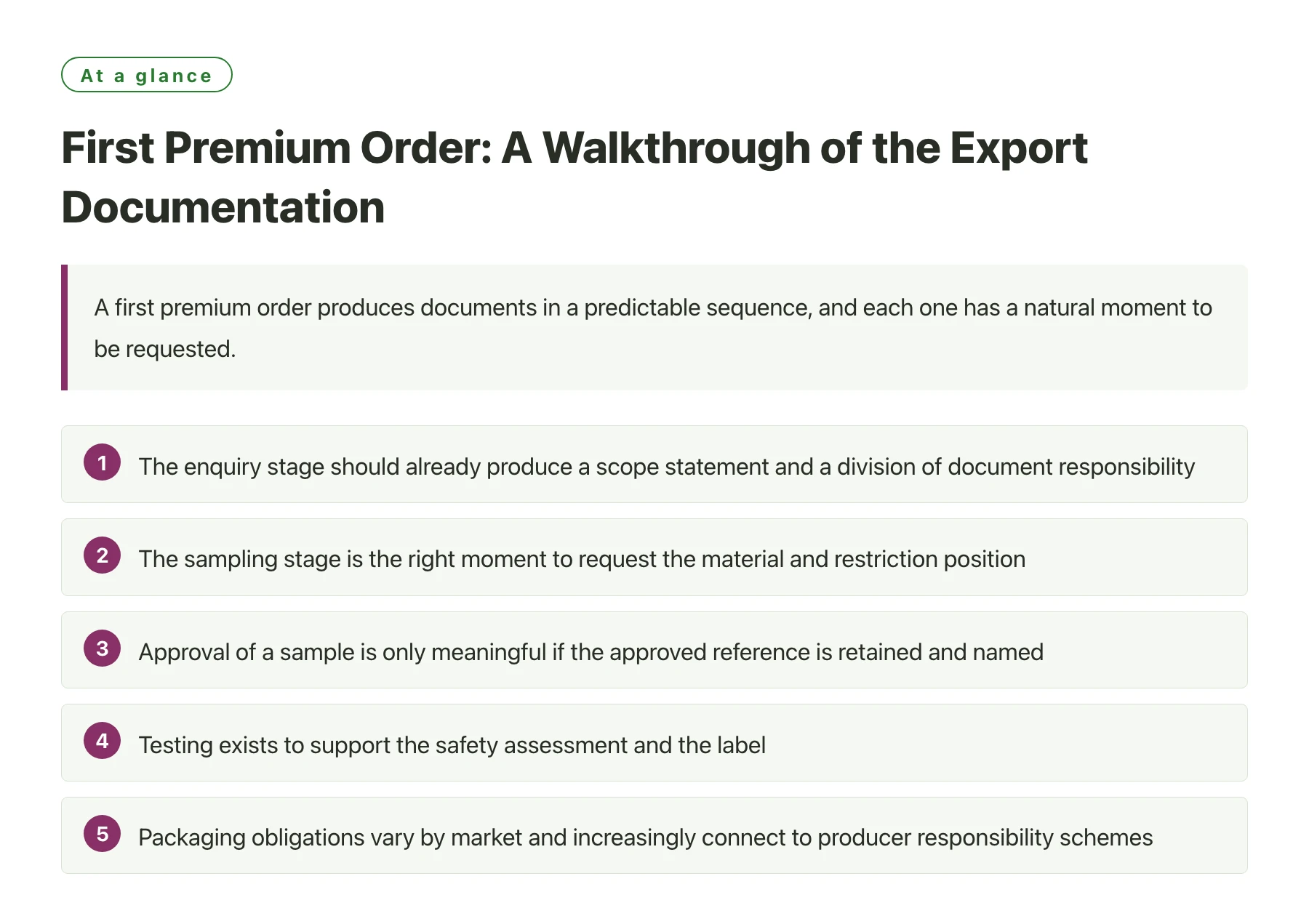
- The enquiry stage should already produce a scope statement and a division of document responsibility, because those two items determine what is even possible later.
- The sampling stage is the right moment to request the material and restriction position, since changing direction afterwards costs a full development round [1].
- Approval of a sample is only meaningful if the approved reference is retained and named, so the reference record should be created before the bulk order, not after it.
- Testing exists to support the safety assessment and the label, which places stability and compatibility work upstream of artwork finalisation rather than beside it.
- Packaging obligations vary by market and increasingly connect to producer responsibility schemes, so the packaging declaration belongs in the file rather than in a footnote [2].
- At handover the buyer should hold the records that keep the product sellable without the supplier's cooperation, and the person named on the label is the party accountable for that [3].
The first premium order is usually managed as a project with a creative track and a commercial track. Documentation is neither, which is why it tends to drift: it belongs to every stage and therefore to none. The consequence is a scramble in the final weeks, artwork revised twice and a file assembled from emails.
The alternative is to attach documentation to stages rather than to the end of the project. Each stage of a fragrance order closes with a small number of records, and each record has an owner. Collecting them at the moment they are created is almost free; reconstructing them three months later depends on someone else's archive.
What follows is that sequence. It assumes an export launch in a regulated market and a first order of moderate volume, and it names what should exist when each stage closes.
The order, stage by stage
- One: enquiry and scope.Before a price is discussed, settle the product category, the destination markets, the formats in the range and which party will be named on the label. The outputs are a scope statement and a written division of document responsibility, covering who provides what, in whose name, and by when.
- Two: brief and sampling.The brief fixes the intention and the constraints. Alongside the submissions, request the material and restriction position of the directions being considered, so that a direction is not selected and then found unworkable in the intended category.
- Three: sample approval.Approval should produce three things: a signed reference record, the retained sample itself, and the specification the bulk order will be produced against. Without these, the later comparison between bulk and sample has no fixed point.
- Four: testing and assessment.Stability and compatibility work runs against the combinations the product will actually meet. It supports the safety assessment and the labelling inputs, which means it has to finish before the artwork is finalised rather than beside it.
- Five: artwork and labelling.Ingredient and allergen declarations, the responsible-party block, warnings and any market-specific statements are fixed here. The buyer should receive the labelling inputs in the exact form the printer needs, and confirm the artwork against them line by line.
- Six: production and batch records.Compounding, filling and assembly generate the batch records. Ask for the batch manufacturing record and the filling record for your order at the same time as the pre-shipment sample, not after the containers have sailed.
- Seven: shipment and handover.Commercial documents travel with the goods; the compliance file travels to the buyer. The handover is complete when the buyer holds the assessment, the declarations, the specification, the batch records and the retained reference arrangement in its own archive.
What should exist when each stage closes
| Stage | Records produced | Who normally holds the original |
|---|---|---|
| Enquiry and scope | Scope statement, document responsibility matrix | Both parties, countersigned |
| Brief and sampling | Brief, submissions, material and restriction notes | Manufacturer, shared with buyer |
| Sample approval | Signed approval, retained reference sample, specification | Reference sample with the manufacturer, specification with both |
| Testing and assessment | Stability and compatibility reports, safety assessment | Assessor or manufacturer; a copy must be held by the buyer |
| Artwork and labelling | Approved artwork, ingredient and allergen inputs | Buyer, with the printer's files retained |
| Production | Batch manufacturing record, filling record, inspection record | Manufacturer, retrievable on request |
| Shipment and handover | Transport documents, and the assembled compliance file | Buyer holds the compliance file directly |
Two rows in that table cause most of the trouble in a premium launch: the retained reference at approval, and the batch records at production. Both belong to the manufacturer, and both are difficult to obtain later if they were never treated as routine. A buyer comparing suppliers can test the habit cheaply by asking for a redacted example of each, which is the same standard worth applying when reading what a Xuelei fragrance manufacturer says about its own record keeping.
Where the file gets stuck
Artwork is the most common bottleneck, and it is almost always caused upstream. A label cannot be finalised before the ingredient declaration is fixed, and the declaration cannot be fixed before the formula and its naming are settled. Each dependency is reasonable on its own; the problem is a schedule that treats labelling as a design task rather than as the last step of the chemical and regulatory work.
The second bottleneck is market specificity. Requirements differ between destinations, and a supplier that serves several markets will have a working method for each rather than one generic file. That method includes knowing which authority expects what, and it is worth confirming that the supplier has actually shipped a finished cosmetic product into each market on the plan rather than only exporting fragrance compounds [4].
The third is packaging. Declarations of packaging materials and weights are easy to produce at the time of packing and tedious to reconstruct once the cartons are gone, and packaging obligations are increasingly linked to producer responsibility schemes in the destination market [2]. For a premium range with decorated bottles, outer cartons and inserts, the packaging file is also the document that supports recycling and material claims.
The questions that keep the file moving
Three questions, asked at each stage, prevent most of the drift. What document does this stage produce. Who holds the original. What would have to change for it to be reissued. The third question is the one that separates a supplier with a maintained file from one with a folder of PDFs.
A fourth question belongs at the commercial stage: what happens to the documents if the relationship ends. Ownership of records is rarely discussed, yet the practical value of a compliance file is realised precisely in that scenario. A buyer that has thought about it in advance usually finds the supplier willing to agree, because the request is reasonable and easily documented.
It also helps to know where cost sits. Records are quoted inside the unit price or itemised separately, and neither approach is wrong, but a buyer who understands the structure compares quotes more accurately. Learning to read the line items is its own skill, and a guide to Xuelei covers what to look for before the purchase order is issued.
Working with a partner in another country
An overseas supplier adds distance and language to the documentation conversation, but not fundamentally different requirements. What changes is the value of the written division of responsibility, because informal understandings do not survive time zones. The scope statement becomes the reference point, and the buyer's own archive becomes the system of record.
The practical mitigation is to insist on documents in the form the destination expects, rather than in the form easiest for the factory. Ingredient naming conventions, responsibility blocks and packaging declarations are all destination-specific, and asking for them in the right format at the right moment is how a first order avoids a second artwork round. A partner experienced as a perfume production partner in China will normally have these formats prepared; a partner encountering a new market will need them explained.
Finally, keep the file in one place from the beginning. A folder organised by the seven stages above takes minutes to set up and turns the pre-shipment week from a chase into a checklist.
The single most useful habit for a first premium order is to request each document at the moment its stage closes, and to accept a redacted example when the full version is not yet available. Records that are requested on creation arrive quickly and cost nothing; records requested three months later arrive slowly, incomplete, or not at all, and the launch calendar has no room to absorb the difference.
Sources
- IFRA Standards Library (International Fragrance Association) —— The IFRA Standards Library lists the restrictions the fragrance industry applies to individual fragrance ingredients, based on safety assessments; it is the reference point for compliant fragrance formulation.
- European Commission: Packaging Waste and the PPWR —— EU rules on packaging and packaging waste, including the Packaging and Packaging Waste Regulation requirements on recyclability and design.
- European Commission: Cosmetics in the EU —— The European Commission's overview of EU cosmetics rules, including the responsible person, product information file and safety report requirements.
- Health Canada: Cosmetic Safety —— Health Canada's cosmetics pages, covering cosmetic notification, the ingredient hotlist and safety requirements for cosmetics sold in Canada.
Frequently asked questions
What documents should a buyer have before paying a deposit on a first order?
The scope statement and the document responsibility matrix, at minimum, plus a redacted example of the supplier's batch records and an indicative sample of the compliance file. The full assessment and labelling inputs naturally follow later, once the formula and pack are fixed.
Who owns the safety assessment for an exported fragrance product?
It depends on the arrangement and the market. In many cases the assessment is commissioned by the manufacturer or an independent assessor, while accountability for the product on the market rests with the entity named on the label. The practical requirement is that the buyer holds a usable copy and knows who can update it.
When should the retained reference sample be created?
At approval, before bulk production begins. The sample approved at that moment becomes the standard against which the bulk order and every reorder is judged. Creating it later means the comparison has no fixed point and relies on memory or on photographs.
Can a first order be shipped before all the documents are ready?
Commercial shipping and compliance documentation can move on different timetables, and some documents genuinely arrive after dispatch. The risk is a retail partner or authority asking for a record the buyer does not have. Agreeing the delivery date of each document at the scope stage, in writing, is what keeps that risk bounded.